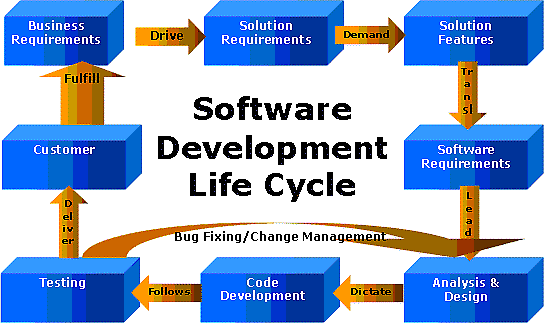
Testing for Something
White box or black box? (Who is using and why?)
Use case?
Prioritize the test into categories
Design for test cases: input, step and output.
Defect tools?
Test Plan is a dynamic document. The success of a testing project depends on a well written test plan document that is current at all times. Test Plan is more or less like a blue print of how the testing activity is going to take place in a project.
| (Scope and objectives) | What we are going to cover |
|---|---|
| Assumptions and Environment | All the conditions that need to hold true for us to be able to proceed successfully |
| Test cases(input, steps, output) | Prioritize test case into categoriesNormal. extreme |
| Roles and Responsibilities | Who is to do whatmodule owners are listed and their contact info |
| Deliverables time | What documents(test artifacts) are going to produce at what time frames |
| Defect management Tools => | For example: JIRA for bug tracking |
| Risk | List of potential risks |
| Exit condition => | When to stop testing |
Java automation testing:
JUnit is a unit testing framework for the Java programming language.
Public void test() {
JunitTesting test = new JunitTesting();
Int output = test.counA(‘alphabet’)
assertEquals(2, output)
}
Black box: internal not known
Grey box: internal partially known
White box: internals fully known
Unit testing- You unit test each individual piece of code. Think each file or class.
Integration testing- When putting several units together that interact you need to conduct Integration testing to make sure that integrating these units together has not introduced any errors.
Regression testing- after integrating (and maybe fixing) you should run your unit tests again. This is regression testing to ensure that further changes have not broken any units that were already tested. The unit testing you already did has produced the unit tests that can be run again and again for regression testing.
- Smoke testing is a subset of Regression testing Smoke testing exercises the entire system from end to end
Acceptance tests- when a user/customer/business receive the functionality they (or your test department) will conduct Acceptance tests to ensure that the functionality meets their requirements.
- Sanity testingis a subset of Acceptance testing Sanity testing exercises only the particular component of the entire system
Analytical skill:
Reproduce the problem =>
- random happen? Or consistent happen
Check out the external and internal situation =>
what is the memory usage of when the system crashes? If … if…..
What version of it? Is the previous version is working, and the newest version is not working, then compare these two and find the difference
memory leakis a type ofresource leakthat occurs when acomputer programincorrectly manages memory allocations. Ex: memory which is no longer needed is not released.
‘Top’
‘Kill [pid]’